


 -Editorial
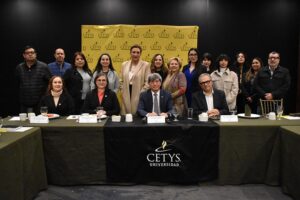
CETYS University President Dr. Fernando León García highlighted the institution’s main achievements in 2025 during a breakfast press conference held at the Araiza Hotel in Mexicali, where he outlined academic, institutional, and regional advances made by the private university system.
In remarks to the media, León García highlighted the institution’s Double Degree program, which allows students to earn a credential valid in both Mexico and the United States and has produced more than 1,200 graduates. He said the program is designed to expand professional opportunities and provide students with a competitive advantage in the labor market.
“Today, students are seeking not only a degree, but also certifications and concentrations that broaden their professional profile, and at CETYS we are aligning our academic offerings with that trend,” León García said.
León García also pointed to student and faculty achievements, noting that students on the Mexicali campus have earned national and international recognition in academic, technological, and athletic competitions. In contrast, faculty members have strengthened the university’s profile through conference participation, academic residencies, and research projects. CETYS reported that 76% of its undergraduate alumni have completed at least one international experience, positioning the institution as a national leader in global education. Through exchanges, short-term programs and its International Summer Program, students and faculty from Mexicali have taken part in academic activities in countries including the United States, Spain, the Czech Republic, Colombia, and China.
The president noted that CETYS has focused on reinforcing its binational and global profile, supporting student mobility, industry collaboration, and programs designed to prepare graduates for competitive international environments.
León Castro called for a shift from bilateral to multilateral collaboration among higher education institutions during a recent discussion on cross-border education, saying the region lacks a unified structure that brings universities together to multiply their impact.
“What we don’t yet have is an action that brings the four institutions together so they unite and multiply the benefits that can be generated,” León Castro said. “This is about creating synergy so that what has been bilateral collaboration becomes multilateral collaboration.”
He said the effort aims to better align universities on both sides of the U.S.-Mexico border to meet shared workforce and community needs in the Cali-Baja and Imperial Valley region.
León Castro said working groups are focusing on three main areas: evaluating existing student and academic mobility between northbound and southbound flows, identifying the region’s evolving talent needs, and expanding university participation in community improvement projects.
“One of the goals is to better understand what talent is needed and how universities, which are already collaborating, can benefit from a broader cross-border vision,” he said, citing sectors such as semiconductors and the role institutions in Arizona, San Diego, and Baja California could play in talent development.
He said a Dec. 12 event formalized an alliance among four universities and that discussions are underway with Baja California state officials to connect the initiative with government efforts in innovation and education.
“This is a call for what is already being done bilaterally to become multilateral and to respond not to one side of the border, but to both,” he said.
León Castro also referenced growing communication between CETYS University and Imperial Valley College leadership and said organizers expect that by mid-year the partnership structure and academic programs will be more clearly defined, similar to collaborations already operating with Southwestern College.

